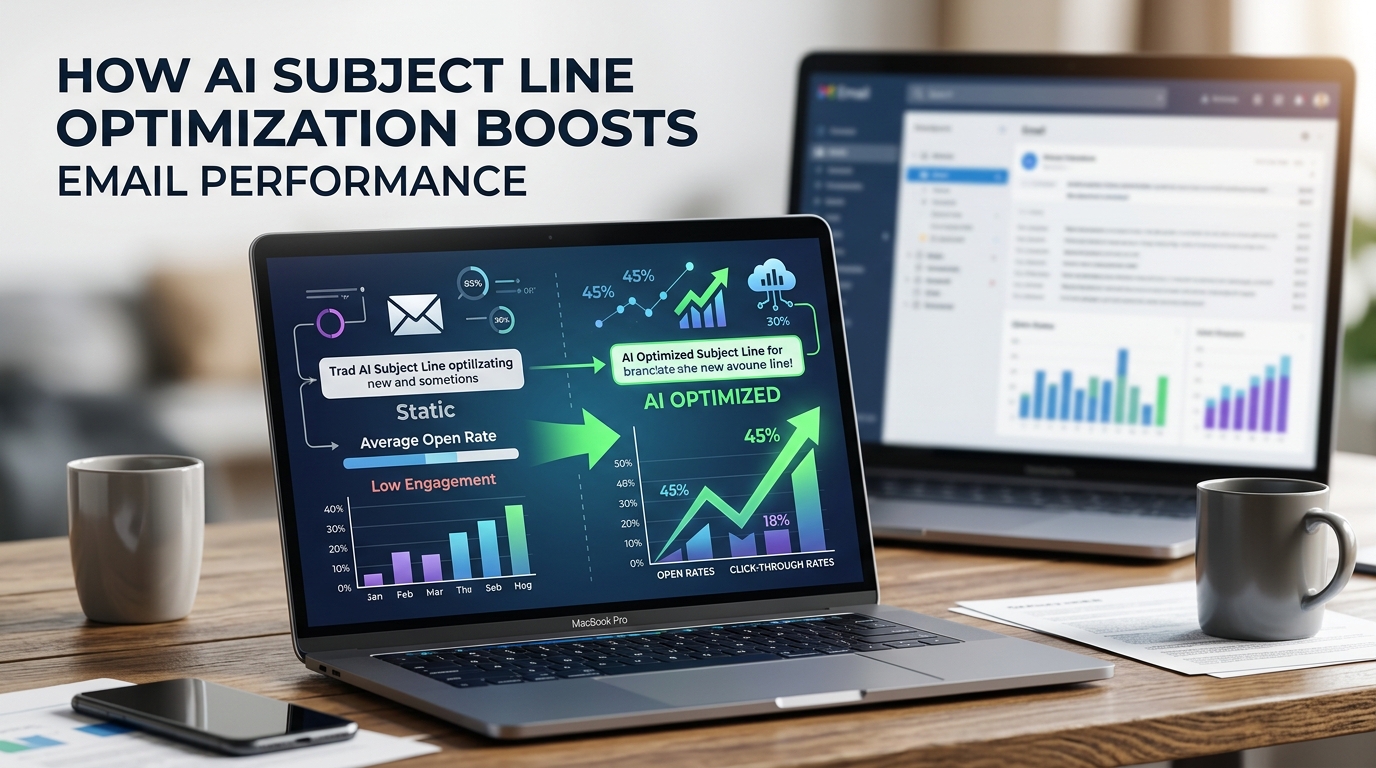
AI is good at a specific, narrow part of subject line work: producing a lot of plausible variants quickly, and spotting patterns across your campaign history that a person scanning a spreadsheet would miss.
It is not good at knowing whether a claim is true, whether an offer exists, or whether a line fits your brand. Those remain yours.
That division of labour is the whole of it. Used well, AI removes the blank-page problem and surfaces patterns worth testing. Used badly, it generates confident nonsense at scale. This guide covers how to get the first outcome.
NevTan Engage is the platform referenced throughout — it includes AI optimization among its core capabilities alongside segmentation, automation, and multichannel delivery.
Key Takeaways
AI generates and ranks. Testing decides. Prediction narrows the field; the A/B test is the ground truth.
Train on engaged contacts only. Cold contacts teach the model that nothing works.
Always review before sending. AI can invent discounts, deadlines, and claims that don't exist.
Open rate is a compromised metric. Privacy features inflate it — confirm every AI win on clicks and conversions.
Small lists get less benefit. Below a few thousand engaged contacts with campaign history, the model falls back on generic patterns.
Track unsubscribes per variant. A line that lifts opens and lifts opt-outs is a net loss.
What AI Subject Line Optimization Actually Does
AI subject line optimization uses machine learning to generate subject line variants and predict which will perform best for a specific audience, based on patterns in your historical campaign data.
It's worth being precise about which parts are genuinely machine learning and which are pattern-matching on language:
Function | What it does | How much it depends on your data |
|---|---|---|
Variant generation | Writes candidate lines from a hook or summary | Little — mostly language modelling |
Style matching | Mimics your brand voice from examples you supply | Moderate |
Performance prediction | Ranks candidates by likely open rate | Heavily |
Pattern surfacing | Identifies what has worked historically | Heavily |
Send-time suggestion | Predicts individual active windows | Heavily |
The first two work reasonably from day one. The last three need history — which is why list size and campaign volume determine how much value you actually get.
What You Need Before Starting
Authenticated sending domain. SPF, DKIM, and DMARC. No subject line rescues mail that's being filtered. See our deliverability guide.
Clean, segmented data. Models learn from what you feed them. A list that's half dormant teaches the model that your audience doesn't respond to anything.
Native A/B testing. NevTan Engage runs the split, calculates significance, and sends the winner automatically.
A defined primary metric. AI optimization targets opens by default. If opens are all you measure, you'll get sensational lines that win opens and lose revenue. Decide upfront whether you're optimizing for opens, clicks, or conversions.
A review step. Non-negotiable, and covered in its own section below.
Awareness of how your data is used. Any AI feature processes your customer data. NevTan Engage publishes an AI and data usage policy setting out how that works — worth reading before you enable anything, particularly if you operate under GDPR or India's DPDP Act.
⚠️ Open Rate Is a Compromised Metric
Since Apple introduced Mail Privacy Protection, open tracking has been unreliable. Privacy features pre-load tracking pixels whether or not a human opened the message, and corporate scanners generate phantom opens.
This matters more for AI optimization than for manual writing, because models trained on open rate are trained partly on noise. Three consequences:
Relative comparison within a test still works — both variants are inflated similarly.
Absolute open rates mean less than they appear to, including any historical baseline the model learns from.
Where possible, train and judge on clicks. If your platform lets you optimize for click rate rather than open rate, do that.
Step 1: Segment Before You Optimize
AI performs best on behavioral cohorts, not on your whole list.
Build an Engaged segment — opened or clicked in the last 30 days — and topic-interest segments based on what people have clicked before. When you promote a piece about deliverability, optimize for the people who've engaged with deliverability content.
Exclude cold and never-opened contacts from training data. This is the single most important input decision. A model learning from contacts who don't open anything will drift toward increasingly aggressive phrasing, chasing a response that isn't there for reasons that have nothing to do with your copy.
Build segments in NevTan Engage's segmentation engine. For structure, see customer segmentation fundamentals and why smart audience segmentation matters.
Step 2: Define One Measurable Goal
Your goal determines what the model optimizes for, and optimizing for the wrong thing produces confidently wrong output.
Write the target as a number: "27% open rate and 6% click-to-open on the launch announcement," not "more opens."
If your goal is | The model should optimize for | Risk if you get this wrong |
|---|---|---|
Content traffic | Click rate | Curiosity lines that open and don't click |
Product sales | Conversion rate | High opens, no revenue |
Reactivation | Open rate | Acceptable — opens are the goal here |
Onboarding | Specific action completion | Clever lines beating clear ones |
Tag destination URLs with UTM parameters so traffic and conversions attribute back to the variant.
Step 3: Generate Variants
Give the model your hook and a short summary. For a post about churn, the hook might be "cut churn by 15%." Expect output across several angles:
Angle | Example |
|---|---|
Curiosity | The churn fix most teams skip |
Benefit | Cut churn 15% with this framework |
Problem | Your churn rate is telling you something |
Personalized | Priya, your retention playbook |
Generate 10–15, shortlist 3–4. The first output is rarely the best, and the shortlisting step is where your judgment about brand voice does work the model can't.
Feed it your best performers. Supplying your top five subject lines from the past year gives the model a concrete target for your voice, which improves output more than any amount of prompt refinement.
Our subject line formula library is a useful reference for judging whether a generated line is structurally sound.
Step 4: Review Before You Test
This step is missing from most AI marketing advice, and it's the one that prevents the expensive mistakes.
Language models generate plausible text, not true text. A model given "our spring campaign" can produce "40% off everything this weekend" — fluent, on-brand, and entirely invented. Sent to your list, that's a promise you have to honour or retract.
Check every shortlisted variant against:
Check | Question |
|---|---|
Factual accuracy | Does every claim, number, discount, and deadline actually exist? |
Body congruence | Does the email deliver what the subject line promises? |
Brand voice | Would you have approved this if a person wrote it? |
Compliance | Any health, financial, or performance claim needing substantiation? |
Personalization tokens | Do fallbacks work when the data is missing? |
Rendering | Does it truncate badly on mobile at 35–45 characters? |
On the advice sometimes given to "trust the model when it feels too edgy": treat brand guardrails as a hard constraint, not a preference to be overridden by predicted performance. A model optimizing for opens has no representation of reputational cost. If a line would embarrass you in a screenshot, don't send it — regardless of its predicted lift.
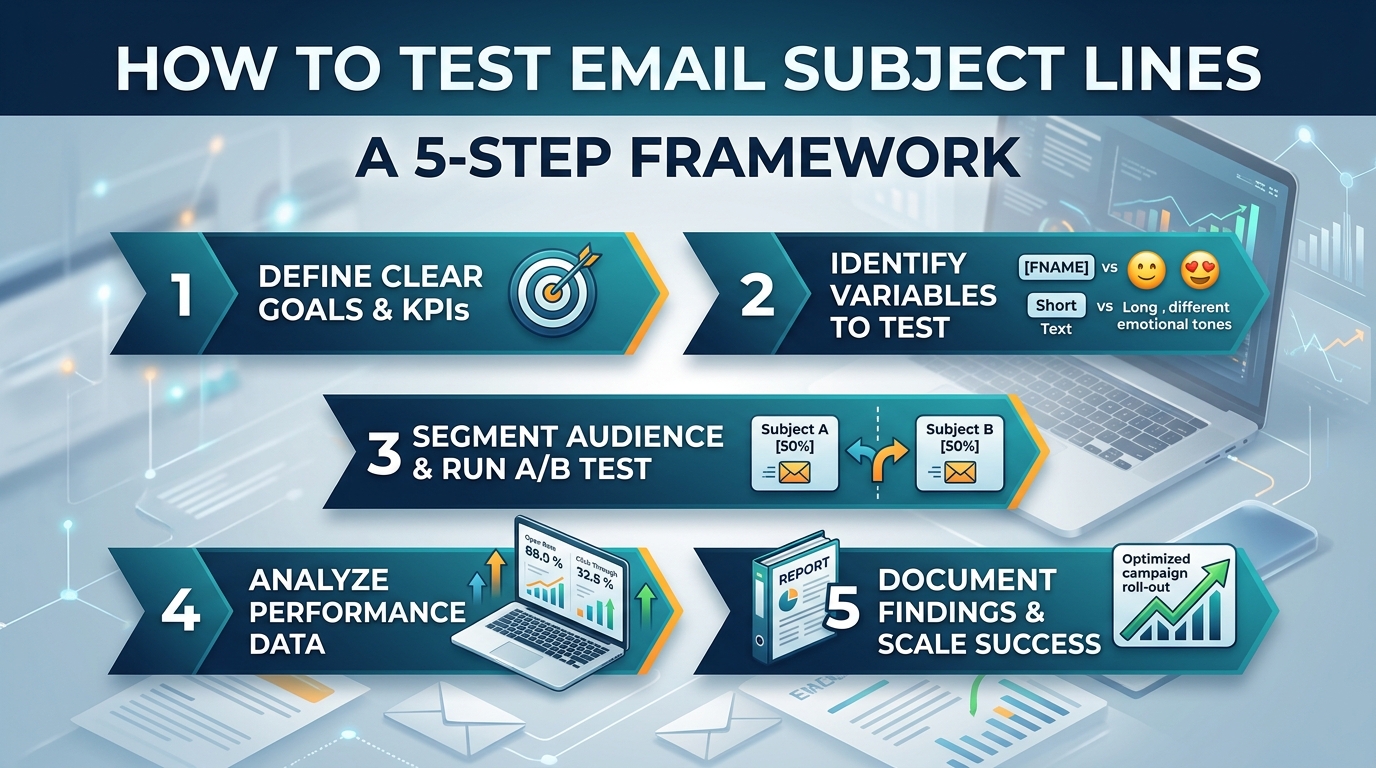
Step 5: Test the Prediction
Prediction narrows the field. The A/B test decides.
Split your engaged segment between two variants, hold back the remainder, and let the winner go to the holdout automatically.
A note on terminology: the holdout is the larger group held back to receive the winner — not the test group. If you split 10,000 contacts as 1,500 / 1,500 to variants, your holdout is the remaining 7,000.
Sizing
There is no universal minimum. What you need depends on your baseline open rate and the effect size you're trying to detect.
Approximate recipients per variant at a 22% baseline:
Relative lift to detect | Per variant |
|---|---|
10% | ~5,700 |
20% | ~1,400 |
30% | ~640 |
50% | ~230 |
Assumes 80% power, 5% significance.
If you're testing two AI variants that differ subtly, you need a large sample. If they differ by angle, a modest one will do. Test across angles, not across rewordings — it's the difference between a detectable result and a coin flip.
Two variants per test. Three or more splits your sample and delays significance.
Run the full window. Stopping when a variant pulls ahead inflates false positives well past the 5% you think you're accepting.
Step 6: Analyze and Feed Back
Metric | What it tells you | Watch for |
|---|---|---|
Open rate | Whether the line earned attention | Privacy-inflated |
Click rate | Total clicks generated | The practical winner |
Click-to-open rate | Whether the email delivered on the promise | Falling CTOR with rising opens = over-promising |
Conversion rate | Business impact | The one that settles it |
Unsubscribe rate | List health cost | Per variant, always |
The CTOR pattern is the one to watch with AI-generated curiosity lines. If opens rise while click-to-open falls, the model is writing cheques the email doesn't cash — it's optimizing exactly what you asked it to and producing a worse outcome.
Unsubscribe rate per variant deserves equal billing. A variant that wins on opens and doubles opt-outs has cost you future revenue to buy present attention.
Build the feedback loop
Log the principle, not the sentence. "Negative-hook framing beat descriptive framing on the engaged segment, twice" transfers to your next campaign. "The 15% churn fix you haven't tried" does not.
Feed those patterns back as context for future generation, and bake winners into your email templates. This is what makes AI optimization compound rather than reset every campaign.
Does It Suit Your List?
Your situation | Realistic expectation |
|---|---|
Under ~1,000 engaged, few past campaigns | Generation help only. The model has no history to learn from — treat it as a brainstorming tool and build your dataset through testing |
1,000–10,000 engaged, 10+ campaigns | Meaningful pattern recognition. Segment-level optimization becomes viable |
10,000–100,000 | Segment-specific optimization with reliable significance testing |
100,000+ | Individual-level dynamic subject lines become practical |
Be honest about which row you're in. Most disappointment with AI subject line tools comes from small lists expecting behavior that requires data they don't have.
Why It Works
Pattern recognition at a scale people can't match. A marketer can review last quarter's campaigns and form impressions. A model can correlate thousands of subject lines against opens, clicks, and timing, and surface non-obvious regularities — that your audience responds to four-to-six-word lines, or prefers "guide" to "tips," or opens more on Thursday afternoons.
Campaign Monitor's research has reported that personalized subject lines see higher open rates than generic ones, though that figure predates current privacy changes and should be treated as directional. AI extends the idea beyond first-name insertion, adjusting tone and angle based on what a contact has previously engaged with — which is the version that actually works, since name tokens have become common enough that most readers filter them out.
The honest limit: subject line effects are audience-specific, and no model transfers a rule from someone else's list to yours. What AI provides is a faster path through the search space. The search still has to happen on your audience.
For the broader picture, see how AI is changing email marketing, and how personalized emails improve retention for the longer-term view.
Common Mistakes
Mistake | Consequence | Fix |
|---|---|---|
Training on unclean data | Model learns list hygiene problems as copy problems | Engaged segment only |
Skipping human review | Invented offers and false claims reach subscribers | Mandatory review checklist |
Testing multiple variables | No attribution | Subject line only |
Optimizing opens alone | Attracts curiosity, not customers | Track clicks and conversions |
Underpowered tests | Noise mistaken for signal | Size against baseline and effect |
Stopping early | Inflated false positives | Pre-commit to the window |
Deferring to the model on brand | Off-voice sends you can't take back | Guardrails are hard constraints |
Never feeding results back | No compounding | Log principles after every test |
More on the surrounding fundamentals in the top mistakes businesses make in email marketing.
FAQ
What is AI subject line optimization?
Using machine learning to generate subject line variants and predict which will perform best for a given audience, based on patterns in historical campaign data. The AI proposes and ranks; an A/B test confirms.
How much can AI improve open rates?
Results vary substantially by list quality, size, and how well the goal is defined. NevTan Engage reports an average open-rate lift of over 38% for customers using its AI optimization. Treat any published figure as a starting expectation rather than a forecast, and note that privacy features make absolute open-rate comparisons less reliable than they used to be — measure your own lift against your own baseline.
Do I need a large list?
For pattern learning, yes — roughly 5,000 engaged contacts with 10–15 past campaigns is a reasonable threshold. Below that, AI still helps with generating variants, but predictions lean on general language patterns rather than your audience's specific behavior.
What's the difference between A/B testing and AI optimization?
A/B testing compares two versions to see which wins. AI optimization generates and ranks candidates before testing. They're complementary — AI narrows the field, testing decides.
Can AI write in my brand voice? Reasonably well, if you give it examples. Supply your best-performing past subject lines and your brand guidelines. Always review output before sending — voice matching is approximate, not reliable.
How does AI handle personalization?
Beyond merge tags, it can adjust angle and tone based on behavior — someone who reads pricing content gets cost framing, someone who reads feature content gets capability framing. This requires unified customer data across channels.
What metrics should I track?
Open rate, click rate, click-to-open rate, conversion rate, and unsubscribe rate — the last two per variant. CTOR catches over-promising; unsubscribe rate catches damage that opens conceal.
Is AI-generated content bad for SEO or deliverability?
Subject lines aren't indexed, so SEO doesn't apply. Deliverability responds to engagement and complaints, not to authorship — a well-performing AI line helps your reputation and a misleading one hurts it, exactly as with human-written copy.
What are the risks?
Fabricated claims are the main one — models generate plausible text, not verified text. Secondary risks: over-optimization for opens at the expense of revenue, and drift away from brand voice over successive campaigns. All three are managed by the review step.
Start With One Campaign
Pick an upcoming send to your engaged segment. Generate a dozen variants, shortlist three, review them against the checklist, and test the two that differ most by angle. Judge on clicks. Log the principle behind the winner.
Do that for a quarter and you'll have something more valuable than any single optimized subject line: a documented record of what your audience responds to, which is the input that makes every subsequent AI suggestion better.
NevTan Engage includes AI optimization alongside segmentation, automation, and multichannel delivery on one customer profile. There's a free plan to start on.